
Meningitis and sepsis often co-occur.
Meningitis can cause blood poisoning, leading to sepsis (known as meningococcal septicaemia).
Meningitis and sepsis can cause death within less than half a day.
Young children especially under 5 are at increased risk as their immune systems are not yet fully developed.
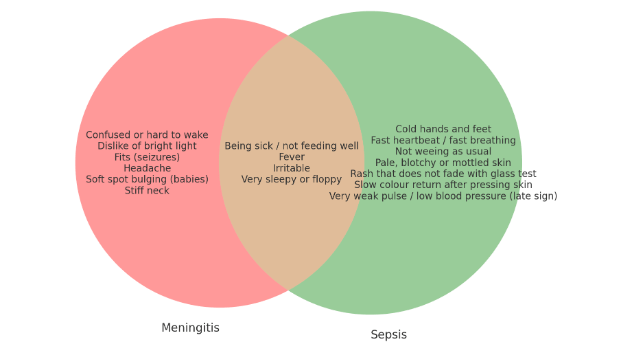
GENERAL SIGNS OF MENINGITIS AND SEPSIS:
The signs can appear in any order. Not all may be present.
Symptoms common to both meningitis and sepsis include:
- Fever – or normal or low temperature especially if very young
- Significant behavioural changes
- Very drowsy
- Unresponsive
- Floppy (baby seems to be more like a “rag doll” due to reduced muscle tension)
- Unusual cry or moaning
- Seems agitated, tense – dislike being handled
- Refusing food and/or vomiting
Meningitis symptoms also include:
- Headache (if child is old enough to describe it)
- In very young babies, bulging top part (soft spot, known as fontanelle) of head.
- Stiff neck
- Dislike of bright lights
- Convulsions and seizures – rhythmic jerking that cannot be stopped with restraining (holding them in place) – changes in eye expression, seem more stiff, change in skin colour, difficulty breathing, changing in responsiveness
Sepsis symptoms also include:
- Cold hands and feet (even if body is warm)
- Rapid or difficulty breathing, weird noises when breathing
- Fast heartbeat
- Decreased urine output
- Younger children – fewer wet nappies than usual
- Older children – no urination in more than 8 hours
- Low blood pressure (will most likely be detected by a healthcare professional – very concerning late sign of going into septic shock)
- Pale, rash on skin that does not fade with “glass test” (see below) [though a meningitis infection can lead to sepsis so meningitis may also be present]
If there are several of these signs or any suspicion that it may be meningitis or sepsis – call 999 or go to A+E IMMEDIATELY!
GLASS TEST
- A rash that does not fade or lose colour when a glass is pressed against it is a huge red flag and immediate medical attention should be sought – call 999 or go to A+E IMMEDIATELY!
- Sign of meningitis or sepsis
- The rash is indicative of possible blood poisoning.
- The rash alone cannot be used to diagnose or confirm meningitis or sepsis as it may not always be present. Do not wait for a rash
How to perform the glass test:
CLINICIAN ASSESSMENT
Circulation:
- Press finger of child – will discolour
- Time it takes to return to normal colour should be ~2 seconds
- >3 seconds = poor circulation
- Detect fast heartbeat with pulse or stethoscope
- Coldness in hands and feet with warm body
Breathing:
- Faster than normal
- Abnormal sounds or grunting
Neurological status:
- Harder to wake, less responsive
- Agitation
- Seizures
Urine output
- Significantly reduced or none within more than 8 hours
Low blood pressure – late sign of going into septic shock:
- If BP systolic <70 + (2 x age in years) [eg: 5 year old BP of less than 80 systolic] for young children <10
If ever in doubt, assume meningitis or sepsis and send to emergency care and then prove otherwise.
HOW MENINGITIS AND SEPSIS CAN BE VERY DANGEROUS AND FATAL:
Both meningitis and sepsis can cause death within less than half a day.
MENINGITIS
Meningitis is not a very contagious disease. Most cases occur in isolation.
There are many types of meningitis depending on which organism caused it.
The two most common are:
- Viral meningitis – the most common and less serious
- Bacterial meningitis – less common than viral but very serious and potentially life-threatening
Other types include:
- Fungal meningitis
- Parasitic meningitis
Non-infectious causes of meningitis include:
- Surgery of head and neck
- Medications
- Brain tumour
- Skull fracture
VIRAL MENINGITIS
- Is more common than bacterial but generally less deadly.
- It can still make people very ill but the vast majority of people recover within 7-10 days
- Can cause after-effects in many cases that can last very long and can impact life significantly
- There is no direct treatment for most cases. Hydration and rest and painkillers is the main regime.
- In severe cases where hospital admission is required, may get started on antibiotics as there is no time to determine whether a bacteria or virus caused meningitis. Even though antibiotics are ineffective against viral cases.
BACTERIAL MENINGITIS
Bacterial meningitis tends to be the more severe form, and is often life-threatening. Rapid transfer to hospital for administration of antibiotics maximises chances of a good outcome.
Thankfully, most people will make a good recovery, especially if identified quickly and treated as soon as possible.
However, up to 10% of cases are fatal.
People carry meningitis-causing bacteria at the back of their throat harmlessly. This allows us to develop immunity.
The bacteria is spread through “close contact” such as sneezing, coughing, surfaces or kissing
Occasionally, the bacteria may slip into the bloodstream to cause meningitis and sepsis.
The most significant bacteria causing meningitis and often sepsis is called “Neisseria meningitidis” – also known as “meningococcus”.
Meningitis after-effects include:
- Hearing loss
- Amputation
- Brain injury affecting behaviour and co-ordination
- Vision problems
- Emotional impact
- Memory loss
- Low energy
- Headaches
SEPSIS:
- Sepsis involves the body having a very harsh response to the infection, damaging its own tissues and organs.
- Any type of infection can cause sepsis; infection of the bloodstream is one way.
Complications and after-effects of sepsis:
The toxins from the bacteria infecting the bloodstream can damage blood vessels, reducing blood flow to the essential organs and causing blood to leak. This lowers blood pressure.
- Multi-organ failure
- Loss of limbs (amputation required if blood flow lost; gangrene)
- Damage to skin and tissue infected
- Issues with bone growth
In the worst case scenario the damage can be so extensive and irreversible that it results in death.
Septic shock – a life-threatening complication of sepsis:
A significant drop in blood pressure can occur, known as septic shock. This further reduces the blood supply to the vital organs.
Septic shock is very deadly, with a fatality rate of 30-40% [8]
Symptoms include:
- Extreme confusion and/or disorientation
- Very sleepy
- Very difficult or impossible to stand up
VACCINATIONS
There are various vaccines available for various types of meningitis. Most babies and children living in UK would be vaccinated against it.
Example vaccine: MenACWY vaccine. Normally offered to teenagers in school.
It should be noted that no vaccine is 100% effective and being vaccinated does not guarantee that a child will not contract the disease and become seriously ill.
THE TAKE HOME MESSAGE: EARLY DETECTION AND INTERVENTION IS KEY FOR BETTER OUTCOMES.
In a study [10], it was found that even just 2 hours of antibiotic treatment delay with bacterial meningitis doubled the risk of death.
The Sepsis Alliance stated that “up to 80% of sepsis deaths could be prevented with earlier detection and treatment. For every hour that treatment is delayed, risk of death increases by 8%” [9]
Earlier detection comes from educating the public and raising awareness so signs are not missed.
SOURCES:
[2] https://www.tiktok.com/@tinyheartseducation/video/7234687213458558209
[3] https://www.meningitisnow.org/meningitis-explained/meningitis-vaccines/
[4] https://www.nhs.uk/vaccinations/menacwy-vaccine/
[5] https://www.meningitisnow.org/meningitis-explained/types-of-meningitis/viral-meningitis/
[6] https://www.meningitisnow.org/meningitis-explained/types-of-meningitis/bacterial-meningitis/
[7] https://www.meningitisnow.org/meningitis-explained/types-of-meningitis/meningococcal-disease/
[8] https://www.mayoclinic.org/diseases-conditions/sepsis/symptoms-causes/syc-20351214
[9] https://www.levinperconti.com/nursing-home-abuse/sepsis/stages/
 Shobz Pharmacy